The Great River, known variously as Ifesa, yisa, and nun, is the largest river in Zitis and serves as a center for commerce, transportation, and religion in the region. Once populated by the Riverine Civilization, their decline led to Wajahe settlement across the river, up to the Third Cataract.
Sections
The Great River is divided into 3 sections, corresponding to subdivisions within The Riverine Culture, subdivisions that remain relevant between the cultures currently residing along its banks. As the course of the river is East to West, the sections are named appropriately. The River has 4 major Cataracts (or whitewater rapid sections) along which river barges cannot cross, and goods (or the barges themselves) have to be moved overland.
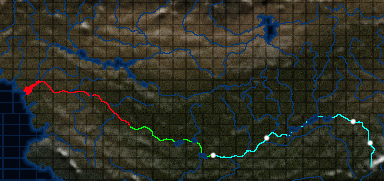 The sections of the main course of the Great River, with the Lower River in Red, Middle River in Green, and Upper River in teal. The Cataracts of the Great River, all of which are on the Upper River, are shown as white circles. Note that the Great Lakes system is a tributary of the Great River, with a large confluence near the river mouth city of Ksy
Lower River
Middle River
Upper River
The Upper River is the section of the Great River beyond the First Cataract. Because of the Cataracts along this section, they have historically housed divergent cultures from the other two sections of the river, with no serious settlement of any culture ever recorded beyond the Third Cataract. The main urban centers of this section lie along the Iron Lakes, known for the vast iron deposits in the region, alongside extremely fertile farmland.
Great Lakes
The Great Lakes lie along the largest single tributary of the Great River, and are the urheimat of the Wajahic peoples, as well as the current homeland of the Lake Wajahe.