The Navy of Koshayis was a major military structure, which began as a wing of the armies of the Wajahe 13th Dynasty but would become effectively an independent state in and of itself. It was established by a decree in 3309 KS, which organized the Ejee sailors of the city of Koshayis into a navy along Wajahe military structure lines, and arranged funds for the construction of a large navy and for the conscription of Ejee shipbuilders across the empire for their designs.
The Navy itself was composed almost entirely of Ejee sailors and soldiers, with only the highest rungs of command being Wajahe (who were, themselves, hardly involved in military operations, and acted more as bureaucrat functionaries). Since the Navy was largely staffed by members of the Ejee religion, its establishment caused a decline in persecutions, especially those directed against shipbuilders and sailors, who used their newfound position to influence the local Archon.
The Decree that established the Navy envisioned a long-term project. Laborers were conscripted for 3-month terms in a Corvee system across 5 years to construct a modern port in the city, including a Cothon. Another 3 years after that were allocated to the construction of ships, and to the retrofitting of purchased ships from merchants or from foreigners. This was funded by a seizure of silver mines near the city, which would be owned by the Navy itself to fund these operations, as well as its future operating costs. This was arranged between the Archons of Hinanrun, Nodotto, and Koshayis, with a great amount of input from local shipbuilders as to the costs and time required for this
The Navy would be structured along military lines, and so would have an Exarch and be divided into Legions. Contrary to most military operations, the Navy involved a major economic and bureaucratic component beyond food and supplies, ie. the ownership and staffing of ships and port facilities (and the silver mines mentioned above). All of this would be organized into a Legion of Bureaucrats and Scribes - in the future, following the Invasion of Sesir and the effective movement of the Navy’s base of operations, this Legion would come to function as the Civic apparatus of the state the Navy found itself running. The other Legions consisted of 100-150 ships of various classes, and these were frequently reorganized for missions.
The Invasion of Sesir
The Invasion of Sesir was a military operation completed in 3331 KS by the Navy of Koshayis - typically consisting of 8 years of raiding between 3323 KS and 3331 KS, and a final capture of the island and city in 3331 KS. As a result of this invasion, the island of Sesir and the nearby coast on the mainland were captured by the Navy of Koshayis, who established a de facto independent state along stratocratic lines that was nominally subservient to the 13th Dynasty.
Background
Sesir, an island in the south-west of Zitis with an Ejee population, had long been ruled by a state well separated from the northern Ejee cities. This state was centered at the city of Sesir, which had its own oracle.
During the period of the 13th Dynasty, the island of Sesir had, for a few centuries, been conducting raids across the coast of Zitis, which only heightened after the conquest of Koshayis by the 13th Dynasty, which caused a major decline in shipbuilding and naval defenses across the region. This raiding was the direct cause for the establishment of the Navy of Koshayis in the first place.
The Oracle of Sesir, which operated in a distinct tradition and lineage from the northern oracles of Koshayis (Sifir) or Svr, had long been openly hostile to mainland Ejee religion, and been regarded as a dangerous heathen by the mainland Ejee. While Ejee religion (and the oracle of Koshayis) were suppressed during this period by the Wajahe, the construction of the Navy of Koshayis gave the Ejee in the Navy more freedom to practice their religion, and significant autonomy in their choice of method by which the raiders in Sesir would be dealt with.
An actual military attack on the city was not seen as a possibility early on. However, around 3326 KS, major unrest began in the city of Sesir, in response to religious tensions, and a loss of fortune by many merchants whose shipping was attacked by the Navy. The Navy made every effort to increase this unrest, largely along religious lines, and they were able to establish a network of agents within the city some years before the invasion began.
Raiding Sesir
The invasion began as a series of counter-raids on the island of Sesir, between 3323 and 3331 KS. During this period, which coincided with increasing local unrest within the city, the Navy of Koshayis would capture and commandeer any ships from Sesir or owned by Sesir merchants, sabotage port facilities across the island, and periodically burn down farmland or fishing villages across the coast in an attempt to induce a famine across the island. Some local merchant/aristocratic families were made exempt from these activities, in an attempt to heighten the unrest, and create a network of individuals that would cooperate with the Navy were it to actually invade.
This period also represents the first time carrier pigeons were used by the Navy to send messages to and from the island and boats off the coast, establishing a strong line of communication between local agents (especially those embedded in fortifications) and the Navy itself (without ever having to land ashore).
It is important to note that, especially early into these raids, none of these activities were seen as a precursor to a future invasion, but rather as offensive action to end raiding and piracy from the island. This was especially the case for the Wajahe within the Navy, who had little desire to invade this faraway island.
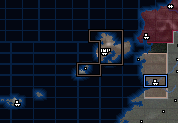 Sesir (brown) before the invasion
The Invasion
In the 9th year of raids (3331 KS) a major force was raised in order to capture the city. The force comprised of 6000 Ejee troops, 550 mercenary auxiliaries, and a 200-strong Legion of Wajahe from Koshayis’ Archon. This force was transported to the shores of Sesir largely by commandeered vessels, and was accompanied by a naval contingent of 120 boats. Upon landing, the expectation was for the vanguard of these forces to link up with around 300 locals aligned with the cause, who would have destroyed fortifications before the linkup, and then to invade and capture the city with this force and assisted by a naval blockade.
The cause for the shift from raiding to direct invasion is not clear. The most common hypothesis is that this was a relatively impulsive decision made by the Navy upon receiving an unusually large silver shipment from their mines. The planning for this assault took 2 months, and by the end of the 1st month, it was clear to Sesir that this invasion was coming, despite faltering attempts at secrecy.
Despite forewarning, Sesir was unable to prevent the landing. While the Navy was understaffed and landing left incomplete for some period of time, around 4500 men would land, who would be immediately hounded by skirmishers and lose around 300 people to these attacks and to infection before reaching a position from which a siege could be mounted. Sometime around then, Sesir had noticed the use of carrier pigeons, and began killing pigeons and burning down coops to stall communications into the city, causing further chaos in the invading forces. Attempts at internal strikes on fortifications were ineffective, and an assault was deemed too costly as the city had well-built walls. However, the attempt to establish a blockade by the Navy of Koshayis succeeded without any issues, and with the loss of only 2 ships.
The invading army settled into a siege, during which they were well supplied. The city of Sesir was fully blockaded, and while there were some attempts to run the blockade, especially at night, it only somewhat prolonged starvation. During this period, one blockade runner was able to sneak the Oracle and his court out of the city into the highlands of the island, which deprived the city of its head of state (and military commander) leaving them without effective leadership.
As morale declines and the military of Sesir is affected by a degree of unrest, the invasion force would dig tunnels under the walls of the city (with the help of internal agents, with whom communication had resumed under the cover of darkness) and capture most of the city. The inner-most walled citadel would remain uncaptured for a week before its surrender after running out of food.
The city was not significantly sacked after its capture, especially as many elites had, by this point, a connection with the Navy, to whom they were now loyal. The Oracle’s palace and citadel were ransacked and burnt to the ground, and on that site, a new administrative district in the Wajahe style was built (originally fairly ramshackle) to serve as the center of the island. Over the next few months, the remainder of the island, as well as a portion of the mainland coast, was captured by the Navy; however, the Oracle of Sesir eluded capture, and was believed to have fled to islands further west (the closest one of which was also captured by the Navy before their hunt ended).
During the entire course of the invasion, the invading forces lost 750 men to a mixture of disease and infection, skirmisher attacks, desertion, and during the final assault. The defenders lost only a 100 men from their 1300-strong force, but the remainder were taken slaves by the Navy itself and would form a slave-legion of the Navy (and were the fighting force largely employed in the capture of the mainland coast).
Aftermath
After the invasion, the Navy of Koshayis found itself in control of a large island, all of its resources (especially its famed iron mines - the most significant source of the metal in southern Zitis), and its port facilities. This was done without any direct oversight or prompting from the Archon of Koshayis, who after the invasion, made no claim to this land for themself or for Chyowo generally. The aristocrats of the 13th Dynasty as a whole remained fairly uninvolved with the invasion or the island after the invasion, and many saw it as a fair conquest by the Navy (and saw no reason to interfere). As a result, the Navy of Koshayis was given essentially no guidance on how to run the island or what to do with it, nor any formal recognition as a New Whiterun (for which they applied more than once, but were rejected, as the nobles of Chyowo saw the administration of such a faraway backwater island as a form of cruel political exile, unbefitting of their class).
During these first few years, the island was run under martial law, and with no direction from Chyowo, this state of affairs continued until martial law, slowly evolving under the pressures of actual city leadership, simply became a de facto legal code for the city. The Exarch of the Navy, which was always chosen from a General of the Navy, was still always a Wajahe from Chyowo, but always one that was aligned with the goals of the Ejee officers, who may have been 1-2 rungs below the Exarch, but were where the real power always lay.
After a few years, the Navy found itself significantly more involved in the affairs of the island, than in Koshayis, and the officers of the Navy spent most of their time governing from Sesir. As a result, the base of operations of the Navy was moved to Sesir itself, and while they still controlled and staffed the port of Koshayis, (and their silver mines near the city), these grew to become a secondary affair as exporting the Iron of Sesir became their primary source of revenue.
The Navy of Koshayis thus grew into a de facto independent state, because the officials of Chyowo rarely ever deigned to interfere in their affairs. The Ejee religion was openly embraced by the Navy as a whole, including its Wajahe members, and an open bounty remained on the head of the Oracle of Sesir (who never surfaced again, and is believed to have taken his own life in order to evade capture and humiliation, ending his line). The Navy would remain aligned with the goals of the 13th Dynasty, and patrol its coast as well as their own coast, something which their own mercantile activities directly encouraged. This state functioned as a true stratocracy, that would very quickly consolidate all power and ownership of resources (at the expense of even those locals that had initially supported them) into the military, and in addition seize all vessels and directly run all trade and shipping.